
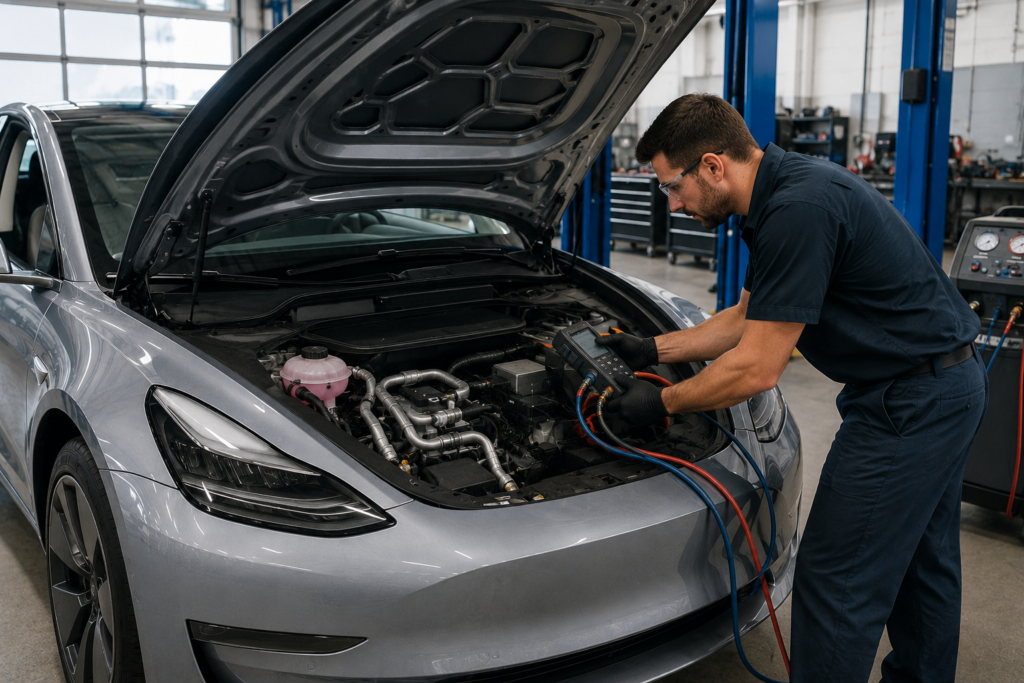
Electric vehicles have changed more than the way cars are powered. They have also changed how heating and air conditioning work. In a gasoline vehicle, cabin heat can often make use of heat already produced by the engine. An electric vehicle does not have that same source of waste heat, so warming and cooling the cabin requires a different approach. That is why heat pumps and advanced thermal-management systems have become increasingly important in modern EVs.
EV Heat Pumps and HVAC Maintenance: What Drivers Should Know
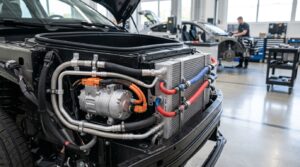 Heating and air conditioning may seem like comfort features, but in an electric vehicle they can directly influence energy use, driving range, battery temperature, charging performance, and overall efficiency. Modern EVs may use electric compressors, heat pumps, coolant circuits, electronic valves, temperature sensors, and sophisticated software to keep both passengers and vehicle components within appropriate temperature ranges.
For drivers, this creates a new maintenance consideration. An EV may not need engine oil changes or many traditional engine services, but its climate-control and thermal-management systems still need attention. Understanding how these systems work can make it easier to recognize problems before they interfere with comfort, efficiency, or vehicle performance.
This topic also connects with our guide to EV battery health. Battery condition and temperature management are closely related because lithium-ion batteries generally perform best within an appropriate operating temperature range.
Why EV Heating Is Different From Gasoline Cars
A gasoline engine produces large amounts of heat while operating. Traditional vehicle heating systems can capture some of that heat by circulating hot engine coolant through a heater core. Air passes across the heater core and enters the cabin as warm air.
An electric vehicle does not produce engine heat in the same way. If the vehicle used only electric resistance heaters, cabin heating could require a meaningful amount of battery energy. Resistance heating works much like an electric space heater: electrical energy is converted directly into heat.
Many newer EVs therefore use heat-pump technology. Rather than producing all cabin heat directly from electricity, a heat pump transfers thermal energy from one area to another. Under suitable conditions, that can reduce the amount of electrical energy required to heat the cabin.
The result is not simply better comfort. Efficient climate control can help preserve more of the battery’s stored energy for driving.
How an EV Heat Pump Works
A heat pump shares some basic operating principles with an air-conditioning system. Refrigerant moves through components that change its pressure and temperature. Depending on system design and operating conditions, the system can transfer heat into the passenger compartment or remove heat from it.
Many modern systems are more complicated than a typical home heat pump because an EV may need to manage several different temperature zones. The cabin needs heating or cooling, while the high-voltage battery, electric motor, inverter, charging equipment, and other electronics may also need thermal control.
That can require multiple coolant circuits, refrigerant lines, pumps, valves, heat exchangers, sensors, and electronic control modules. Software determines how these components work together depending on outside temperature, cabin settings, battery temperature, charging activity, and driving conditions.
Common EV thermal-management components may include:
- Electric air-conditioning compressor
- Heat-pump components
- Refrigerant lines
- Coolant pumps
- Heat exchangers
- Electronic expansion valves
- Cabin temperature sensors
- Battery temperature sensors
- Cooling fans
- Electronic control modules
The exact design varies significantly among manufacturers and models. Some EVs use heat pumps, while others rely more heavily on resistance heating or a combination of technologies.
Thermal Management Is About More Than Cabin Comfort
One of the most important things EV owners should understand is that heating and cooling are not limited to the passenger compartment. Thermal management may also be responsible for controlling battery and power-electronics temperatures.
The high-voltage battery can generate heat during driving and charging. Electric motors, inverters, and charging electronics can also create heat. When temperatures rise, the vehicle may activate pumps, fans, chillers, or other cooling components even if the cabin air conditioner is not being used.
During cold weather, some vehicles may warm the battery before fast charging. Bringing the battery closer to an appropriate operating temperature may improve charging conditions and help the vehicle manage battery performance.
That is why an HVAC or thermal-management problem can sometimes affect more than passenger comfort. Depending on vehicle design, it could also influence charging speed, range, or powertrain operation.
How HVAC Use Can Affect EV Range
Everything powered by an EV battery uses some of the vehicle’s stored energy. That includes the motor that moves the car, but also headlights, electronics, heated seats, cooling pumps, and climate-control equipment.
Heating can become especially important during winter. Because an electric vehicle cannot rely on large amounts of waste engine heat, keeping the passenger compartment warm requires energy from the battery.
Research published by SAE International in 2026 continues to examine ways of reducing HVAC energy demand in EVs. Studies have investigated preconditioning and heat-recovery strategies because heating and cooling loads can affect vehicle energy consumption and available driving range.
This does not mean drivers should avoid using heat or air conditioning. Comfort, visibility, and windshield defogging are important. Instead, drivers should understand that climate use is one of several factors affecting real-world range.
Factors that may influence EV climate-control energy use include:
- Outside temperature
- Cabin temperature setting
- Vehicle insulation
- Heat-pump efficiency
- Number of passengers
- Windshield defrost use
- Battery temperature
- Whether the vehicle was preconditioned while plugged in
What Is EV Preconditioning?
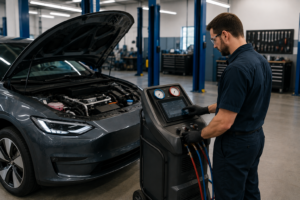 Preconditioning allows some EVs to heat or cool the cabin before the driver leaves. When the vehicle is connected to external power, preconditioning may allow some of the energy needed for climate control to come from the charging source rather than relying entirely on stored battery energy after departure.
Some vehicles can also prepare the battery for driving or fast charging. This can be particularly useful in very cold conditions because battery temperature influences performance and charging behavior.
Drivers should follow the procedures recommended by their vehicle manufacturer because preconditioning features vary by model. Some vehicles manage the process automatically when a charging station is entered into the navigation system, while others provide scheduling controls through the infotainment system or mobile application.
Signs an EV Heat Pump or HVAC System Needs Attention
A heat-pump or climate-control concern may first appear as an ordinary comfort problem. The cabin may take longer to warm, the air conditioner may not cool properly, or airflow may seem weaker than usual. However, drivers should also pay attention to changes in efficiency or system behavior.
Modern EVs often monitor thermal systems electronically. If a sensor, pump, valve, compressor, or control circuit develops a problem, the vehicle may store diagnostic trouble codes even when the symptoms are not obvious.
Possible signs of an EV HVAC problem include:
- Cabin does not heat effectively
- Air conditioning is warmer than expected
- Unusual noises when the climate system starts
- Climate control works inconsistently
- Unexpected decrease in efficiency or range
- Windshield defrost performance becomes weak
- Vehicle displays a climate or electrical warning
- Charging behavior changes alongside temperature warnings
Not every range decrease indicates an HVAC failure. Weather, speed, tire pressure, driving style, battery temperature, and road conditions can all affect efficiency. That is why proper diagnosis is important before assuming a particular component has failed.
Why Refrigerant Service Can Be Different on EVs
Air-conditioning service on an EV should not automatically be treated exactly like service on an older gasoline vehicle. Many electric vehicles use electrically driven compressors rather than belt-driven compressors connected to an engine.
High-voltage electric compressors may require specific refrigerant oils and service procedures. Introducing incompatible lubricant or contamination into certain systems can create electrical or component concerns. Refrigerant specifications also vary among vehicles.
That makes manufacturer service information important. A technician should know which refrigerant, lubricant, equipment, and procedures apply to the specific vehicle being serviced.
Modern automotive repair increasingly requires this kind of vehicle-specific knowledge. Our article on why choosing the right auto repair shop matters discusses the importance of proper equipment and diagnostic capability.
Cabin Air Filters Still Matter
Not every EV HVAC service involves advanced high-voltage equipment. One familiar maintenance item remains important: the cabin air filter.
The filter helps remove dust, pollen, debris, and other particles from air entering the passenger compartment. A heavily restricted filter may reduce airflow through the vents and make the climate system seem less effective.
Replacement intervals depend on the vehicle, environment, and driving conditions. Vehicles driven in dusty areas or heavy traffic may need cabin filter inspection more frequently than vehicles operated in cleaner environments.
Drivers who notice weaker airflow, unusual odors, or more difficulty clearing windshield fog may want to have the cabin filter inspected along with the rest of the HVAC system.
EV HVAC Systems Depend Heavily on Sensors and Software
Modern climate systems rely on much more than switches and refrigerant. Sensors may monitor cabin temperature, outside temperature, humidity, refrigerant pressure, coolant temperature, battery temperature, and component operation.
Control modules use that information to determine when to run compressors, pumps, fans, valves, and heaters. As a result, a problem may sometimes be electronic rather than purely mechanical.
A technician may need to retrieve fault codes, examine live sensor data, perform system tests, and confirm software status before identifying the cause of poor HVAC performance.
This is another example of the shift discussed in our article on how OTA updates are changing vehicle maintenance. Software and electronic controls increasingly influence systems that were once primarily mechanical.
Why DIY Refrigerant Work Can Be Risky
Drivers may see inexpensive refrigerant recharge kits in stores and assume an EV air-conditioning problem can be solved by simply adding refrigerant. That approach can create problems.
If refrigerant is low, there may be a leak that should be identified. Adding too much refrigerant can also affect system operation. More importantly, EV HVAC systems may contain high-voltage components and require specific equipment or lubricant compatibility.
Handling refrigerant also involves environmental and service requirements. For those reasons, climate-control problems involving refrigerant or high-voltage equipment are generally better evaluated with appropriate professional equipment.
Simple Ways Drivers Can Support EV HVAC Performance
EV owners do not need to understand every valve and refrigerant circuit to take care of the climate system. Basic habits can help drivers notice changes and use the system more effectively.
Helpful EV climate-control habits include:
- Use preconditioning when appropriate and supported by the vehicle.
- Replace the cabin air filter according to manufacturer guidance.
- Pay attention to unusual HVAC noises.
- Do not ignore climate-control or thermal-system warning messages.
- Have weak heating or cooling performance diagnosed rather than repeatedly adding refrigerant.
- Keep vehicle software current when manufacturer updates are available.
- Follow the owner’s manual for cold-weather and hot-weather operation.
Heat Pumps Do Not Eliminate Cold-Weather Range Loss
A heat pump can improve heating efficiency under many conditions, but it does not make an EV immune to winter range changes. Cold batteries can temporarily store and deliver energy differently, tires may have greater rolling resistance, roads may be wet or snowy, and cabin heating requires additional energy.
Extremely low temperatures may also reduce how efficiently some heat pumps operate, depending on system design. Vehicles can supplement the heat pump with resistance heating or other strategies when needed.
Drivers should therefore think of a heat pump as one tool for improving thermal efficiency, not as a guarantee that winter range will always match warm-weather range.
Final Thoughts
EV heat pumps and HVAC systems demonstrate how automotive maintenance is changing. Heating and cooling are no longer just about keeping passengers comfortable. In an electric vehicle, thermal management may also influence battery temperature, charging, efficiency, and driving range.
That makes routine awareness important. Drivers should pay attention to changes in cabin heating, air-conditioning performance, unusual noises, warning messages, and unexpected efficiency changes. Cabin filters still need maintenance, while refrigerant, compressors, sensors, coolant circuits, and high-voltage equipment may require specialized diagnosis.
As electric vehicles continue to develop, thermal management will remain a major engineering focus. For drivers, the practical approach is straightforward: understand what normal operation feels like, follow manufacturer maintenance recommendations, and have unusual heating or cooling behavior properly diagnosed rather than ignored.
For additional technical background, see SAE International research on climate heat recovery in electric vehicles, SAE research on smart EV climate control, and U.S. Department of Energy electric vehicle guidance.